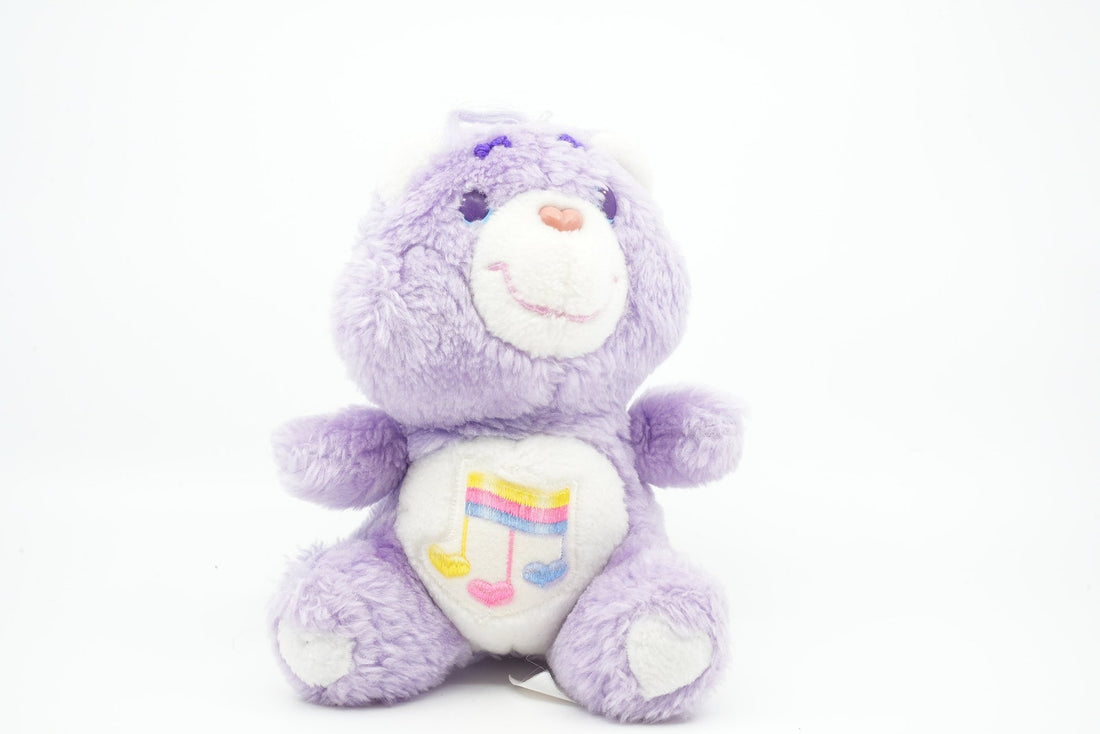
How to identify vintage Care Bears from the 1980s
Share
The Care Bears started as greeting-card characters by American Greetings in 1981. The plush bears that most collectors look for were made by Kenner from 1983 into the late 1980s. Here is how to recognise one, written from the bears that pass over my desk every week.
1. Look for the red heart button
Original Kenner bears have a small red plastic heart with the words Care Bears on their bottom. Later reissues often have a heart too, so the button alone is not proof, but a bear without one is usually not a 1980s Kenner bear.
2. Read the tush tag
The fabric tag at the bottom names the maker and a year. A 1980s Kenner bear shows Kenner and a year from 1983 onwards, together with the country where it was made. Reissues from the 2000s name other makers, such as Play Along. A faded but readable tag is fine; a missing tag lowers the value.
3. Check the tummy symbol
Each bear has its own symbol on the tummy: a rainbow for Cheer Bear, a rain cloud for Grumpy Bear, a sun for Funshine Bear, a four-leaf clover for Good Luck Bear, a moon for Bedtime Bear and a heart for Tenderheart Bear. On the originals the symbol is a separate appliqué. Worn, peeling or stained symbols cost a lot of value.
4. Know the Cousins
From 1984 the Care Bear Cousins joined the line: animals such as Brave Heart Lion, Lotsa Heart Elephant and Bright Heart Raccoon. They were made in smaller numbers than the bears, and the latest Cousins, like Noble Heart Horse and Treat Heart Pig, are among the rarest Care Bears toys of all.
5. Size and condition
The common size is about 33 cm (13 inch); there are also small and large versions and poseable figures. Clean, full fur, an intact nose and eyes and a clear symbol matter most. A bear that still has its original box is worth clearly more.
What is mine worth?
See the price table in our Care Bears value guide, or browse the vintage Care Bears we have in stock. Every bear we sell is checked this way before it is listed.